Functionality, features and workflows
Improving interpretability with Machine Learning
- Details
- Written by: Paul de Groot
Today, we show another great example of how you can quickly improve the interpretability of seismic data by applying a trained Machine Learning model.
DeSmile is one the models from Lundin-GeoLab (nowadays AkerBP) that is available in OpendTect’s growing library of trained ML models
High-Resolution 3D Waveform Segmentation
- Details
- Written by: Paul de Groot
In April 2022, Friso Brouwer of I^3 GEO, conducted an OpendTect webinar in which he showed how high-resolution 3D waveform segmentation can be used for quick geomorphological analysis.
In this post, we show another application of Friso’s workflow. We use the Delft survey, which is freely available from TerraNubis, our cloud portal. Delft is one of several free projects that do not check for license keys, meaning you can run OpendTect Pro and commercial plugins on this dataset.
Dip Steering: Improving multi-trace attributes
- Details
- Written by: Hesham Refayee
Dip Steering is a commercial plugin of OpendTect Pro for computing and using dip and azimuth volumes (Steering Cubes) from seismic data. This powerful tool enables users to:
- Apply structurally oriented filters
- Extract mult-trace attributes along seismic reflectors
- Compute volume curvature attributes
- Extract horizons individually, or as a dense set (HorizonCube) using inversion-based flattening algorithms.
Superior fault imaging using OpendTect's Faults and Fractures plugin
- Details
- Written by: Hesham Refayee
OpendTect supports the most advanced fault attributes available in the market through its Faults and Fractures plugin. Thinned Fault Likelihood or TFL is designed particularly for mapping and imaging faults and fractures based on their dips and strike range. The output is a probability volume with a razor-sharp image of the faults that can be used to extract fault planes.
Read more: Superior fault imaging using OpendTect's Faults and Fractures plugin
Thalweg Tracker: Geobodies Extraction tool
- Details
- Written by: Hesham Refayee
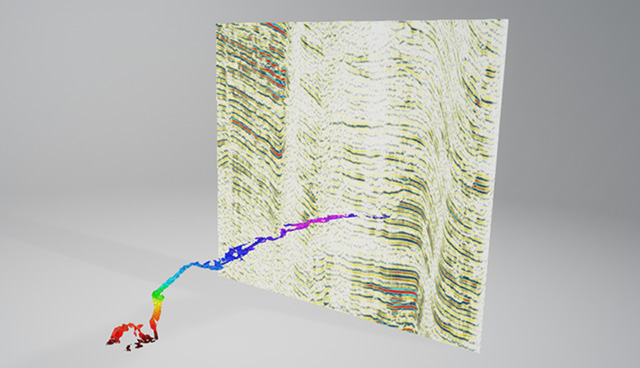
A unique piece of functionality in OpendTect Pro is the Thalweg tracker.
A Thalweg tracker is a 3D amplitude tracker that grows 3D bodies along the path of least resistance. The tracker has two main applications:
- to detect and isolate 3D bodies of sedimentary features such as channels, lobes, splays, and reef buildups, and
- to create labels for supervised Machine Learning seismic facies segmentation workflows.

OpendTect vs OpendTect Pro
- Details
- Written by: Marieke van Hout
In this video Paul de Groot from dGB Earth Sciences explains the main differences between the free platform OpendTect and our commercial platform OpendTect Pro.
Integrated Machine Learning Rock Property Prediction Workflow
- Details
- Written by: Hesham Refayee
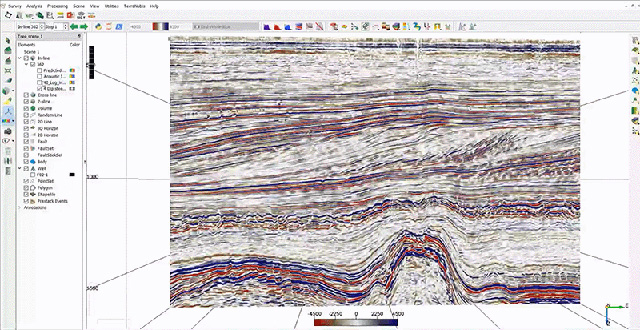
OpendTect allows geoscientists to integrate and transform data from 1 D model to a predicted 3D rock property cube.
Read more: Integrated Machine Learning Rock Property Prediction Workflow
Fault Dip and Azimuth for Machine Learning Fault Likelihood
- Details
- Written by: Paul de Groot
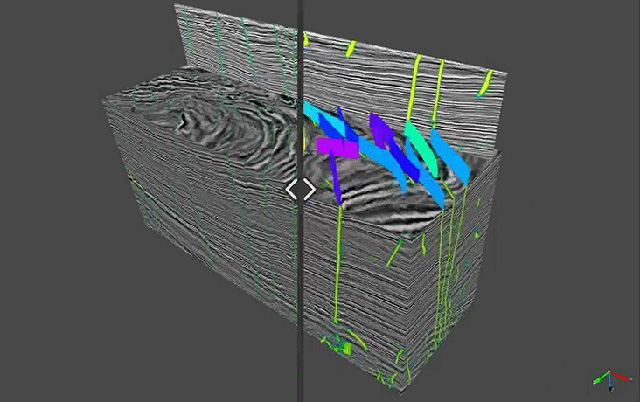
In today’s post we share an elegant workflow proposed by Roar Heggland of Equinor ASA to compute Fault Dip and Fault Azimuth for Machine Learning predicted Fault Likelihood (ML-FL).
Read more: Fault Dip and Azimuth for Machine Learning Fault Likelihood
Removing noise and artifacts from (Thinned) Fault Likelihood
- Details
- Written by: Marieke van Hout
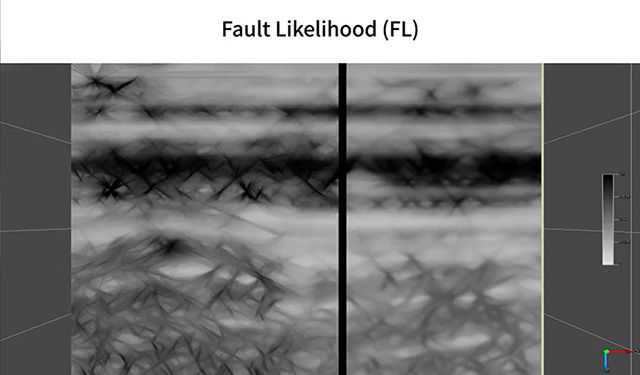
Fault Likelihood (FL) and its derivative Thinned Fault Likelihood (TFL) facilitate structural interpretation. Both volumes have three components: Fault Likelihood, Fault Dip and Fault Azimuth and both can be used as input for Automatic Fault plane Extraction (AFE). However, we recommend to use FL as input to AFE.
Read more: Removing noise and artifacts from (Thinned) Fault Likelihood