General
-Geothermal-Energy-Field-Trip-to-Piesberg-Recap.jpg)
LUC (Low Unit Cost) Geothermal Energy – Field Trip to Piesberg Recap
- Written by: Marieke van Hout
Yesterday, we had the opportunity to explore the Piesberg quarry in Germany as part of our ongoing geothermal investigation for the Municipality of Dinkelland (Denekamp). This field trip is a component of the LUC Geothermal Energy project, aimed at identifying cost-effective and sustainable geothermal energy sources in the Twente region.
Read more: LUC (Low Unit Cost) Geothermal Energy – Field Trip to Piesberg Recap
Pioneering in Machine Learning
- Written by: Paul de Groot
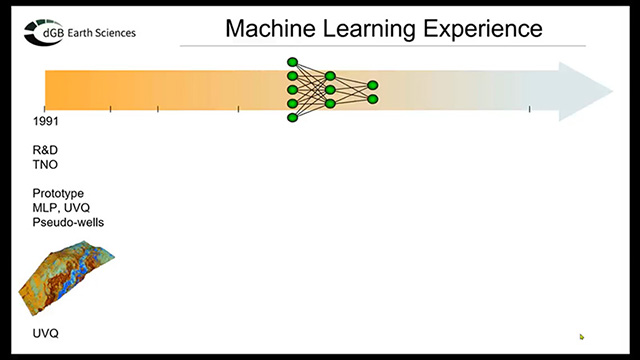
With over 30 years of experience in Machine Learning, dGB Earth Sciences continues to innovate in the field of seismic reservoir characterization.
Today, we take a trip down memory lane to showcase our journey and highlight our latest breakthroughs.
Carbonate Buildup Interpretation
- Written by: Paul de Groot
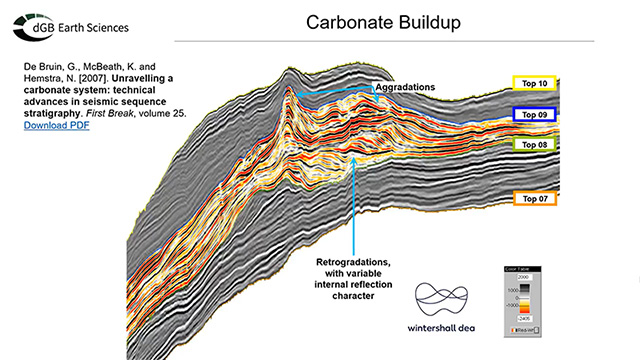
In seismic sequence stratigraphic studies, we analyze seismic reflection patterns in the context of a chronostratigraphic framework. In OpendTect, such frameworks are defined by a HorizonCube, which consists of a dense set of horizons representing Relative Geologic Time. The SSIS (Sequence Stratigraphic Interpretation System) plugin is an add-on that uses HorizonCube input to decompose depositional systems over geologic time.
Seismic Interpretation Services
- Written by: Paul de Groot
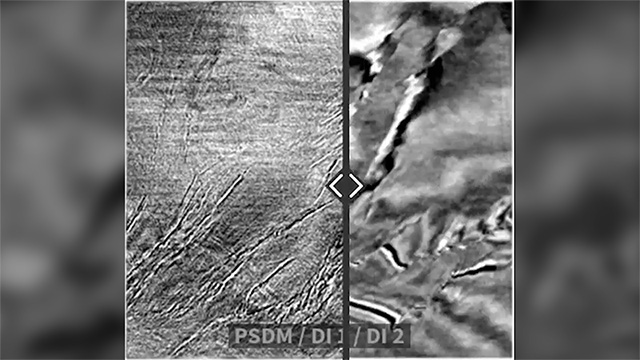
Next to developing OpendTect we also offer advanced seismic interpretation services. Our experts have worked on data sets from around the globe. We have extensive experience in hydrocarbon exploration, field development, time-lapse monitoring, unconventional plays and geothermal studies.
OpendTect is now STL compatible thanks to BGE sponsoring
- Written by: Marieke van Hout
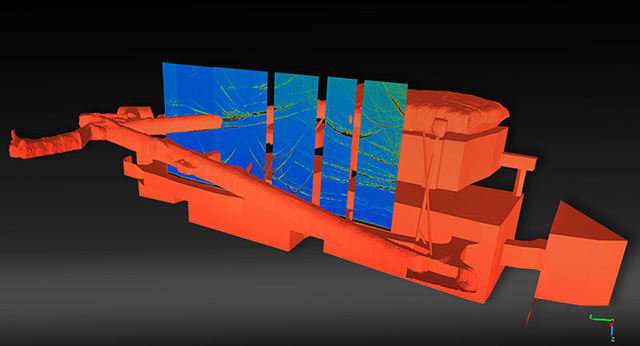
Our latest OpendTect v6.6.8 supports STL format. This is a format used in the Computer Aided Design industry to design 3D objects. It is used in the Mining industry to show subsurface constructions such as mines. A nice feature (not shown) in OpendTect is that you can display attributes on the surface of the 3D body. For example displaying fault attributes would show where faults are intersecting the structure
Read more: OpendTect is now STL compatible thanks to BGE sponsoring

Upcoming Price Increase
- Written by: Paul de Groot
We’ve held our prices pretty much constant for a considerable time now but due to spiraling inflation we will be increasing our prices by 10% in the new year.
The updated prices will allow us to maintain and improve our standards for excellence. We will keep pushing the boundaries of technology, improving OpendTect's performance and support, so that we can continue to give you the very best value for money.
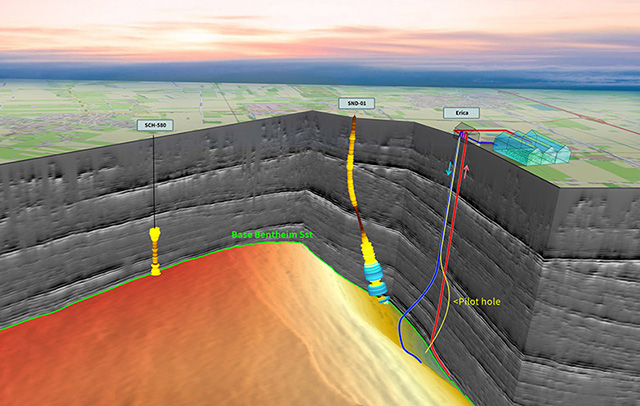
Low Unit Cost (LUC) Geothermal Installations
- Written by: Marieke van Hout
Geothermie Groep Nederland (GGN), dGB Earth Sciences and two suppliers of high-performance drilling services have joined their expertise to harvest low-enthalpy geothermal energy with temperatures ranging from 60 – 90 0C using LUC installations. LUC’s enable economic development of geothermal energy for domestic heating and heating of greenhouses, also from lower-quality aquifers in smaller-scale projects. The method consists of an innovative combination of project management, best-practices in well engineering, production technology and advanced reservoir management.
Cyber Security Certified - Saudi Aramco’s stamp of approval
- Written by: Arjan Burggraaf
We are proud to announce that we have officially received Saudi Aramco's Third Party Cybersecurity Compliance Certificate (CCC).
Read more: Cyber Security Certified - Saudi Aramco’s stamp of approval
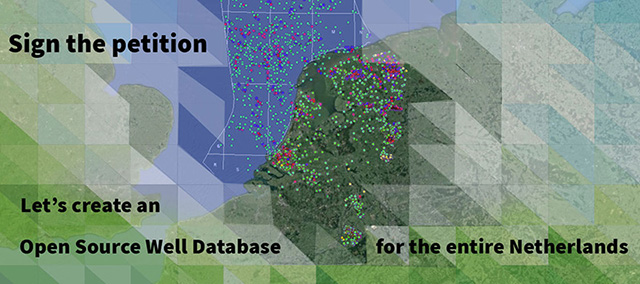
Petition to support the creation of a comprehensive, consistent, open-source well database, for the entirety of The Netherlands
- Written by: Lloyd van Hout
dGB Earth Sciences and Panterra have started a petition
to support the creation of a Digital Well Database
for all publicly-released well data in The Netherlands.